Many businesses don't lose money because of bad ads. They lose it because of the wrong page after the click. The only question is: classic landing page or funnel? An honest answer with numbers, industry benchmarks, and a decision checklist for SMEs.
At a glance
- Funnel pages can deliver 2-3x higher conversion rates than classic LPs on paid traffic
- Classic LPs win on SEO, high-intent buyers, and premium positioning
- Tooling costs: 30-90 € / month for funnel builders vs. near-zero running costs for a classic LP
- Best strategy for most SMEs: both in parallel, not either-or
The Question Every SME Owner Asks
You run ads on Meta or Google. You invest budget in reach. And then the clicks land on your website. But where exactly? On your homepage? On a classic landing page? Or on one of those modern funnel pages with step-by-step questions you've seen yourself in your feed for months now?
This decision is not trivial. It can cost or save 30 to 70 percent of your ad budget. And it doesn't depend on what's currently trending, but on what fits your business model.
In this article, we'll clarify: What exactly is a classic landing page? What is a funnel page in the style of Perspective, Heyflow, or Typeform? Which numbers support which approach? And most importantly: Which variant brings more inquiries to your business?
What Is a Classic Landing Page?
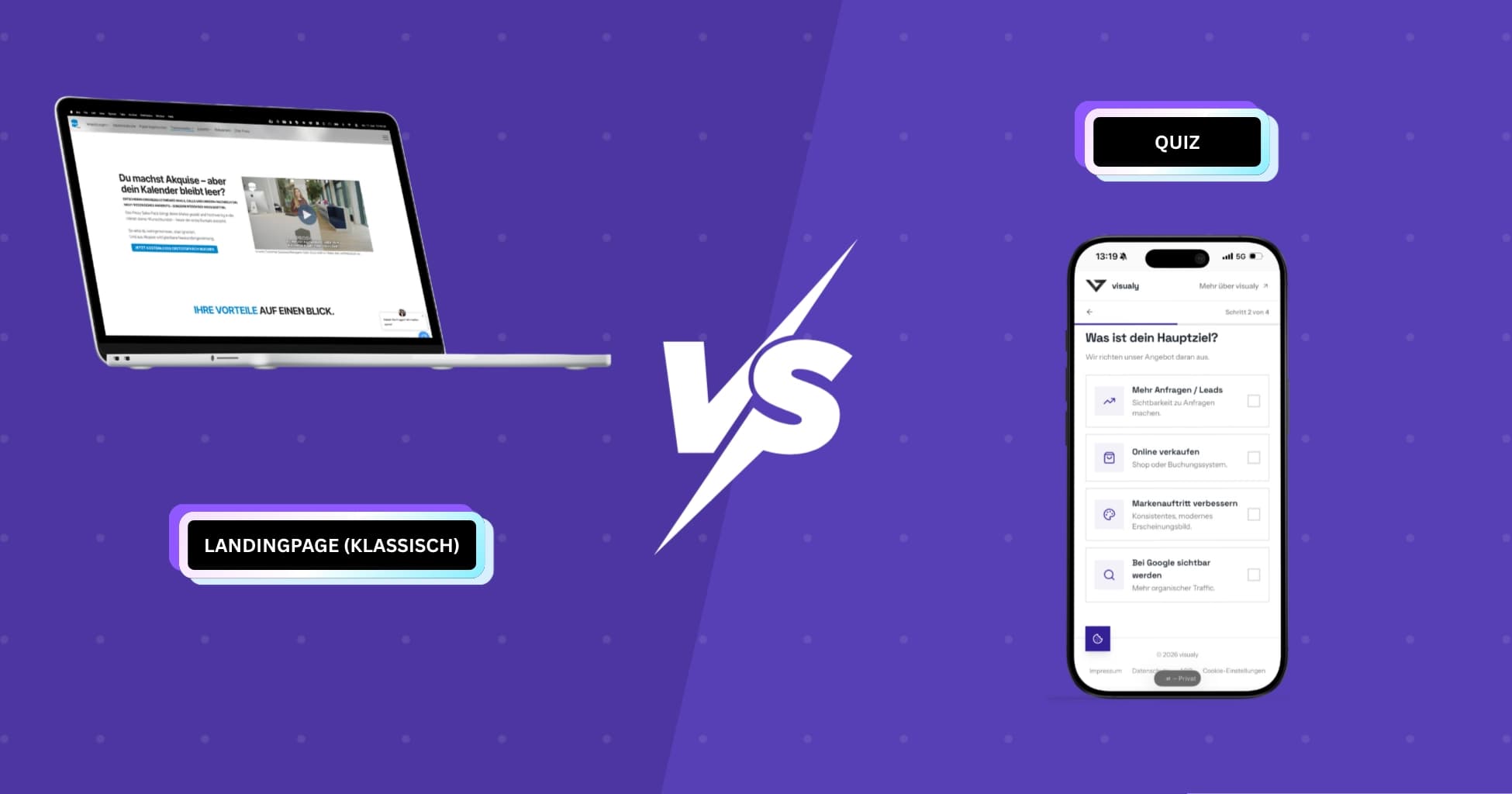
A classic landing page is a single, scroll-based page with a clear goal: turn visitors into leads or buyers. Its structure has followed a proven pattern for years:
- Hero section: Headline, subline, and a clear call-to-action above the fold
- USP section: What sets you apart from the competition?
- Social proof: Customer testimonials, ratings, logos of existing clients
- Service or product details: What does the customer concretely get?
- Objection handling: Frequently asked questions, trust elements, guarantees
- Conversion element: Form, booking link, or contact option
The visitor decides on a single page whether to convert. They see all the information at a glance and can scroll, compare, weigh up at their own pace. This is both the strength and weakness of the format.
What Is a Funnel-Style Page?
A funnel-style page, sometimes called a step LP or quiz funnel, inverts the concept. Instead of one large page, content is presented in multiple small steps. Each step shows only one question or content block. The user clicks their way through.
Typical flow:
- Entry question ("What is your goal?")
- 2 to 5 additional qualifying questions
- Optional value block (tips, personalized assessment)
- Contact data input as the final step
- Confirmation page or direct booking
Tools that enable this approach have grown significantly in recent years. Perspective, a funnel builder from Berlin, has become especially popular across the DACH region. Alongside it are Heyflow, Typeform, and Tally, which follow similar approaches. What they share: they are mobile-first by design and visually closer to an app than a traditional website.
Why Funnels Convert Higher
The numbers are striking. Analyses from 2024 and 2025 show that multi-step forms achieve an average conversion rate of 13.85 percent, while classic single-page forms sit at 4.53 percent. That is roughly a 3x lift.[3]
3x
higher CVR
Multi-Step vs. Single-Page
+743%
Conversion lift
B2B SaaS case study
2.3x
Lift
Heyflow: static → interactive
In a well-documented B2B SaaS case study, the conversion rate of an inquiry form rose from 0.96 percent to 8.1 percent simply by splitting 11 fields across three steps. A +743 percent increase, with no new headline, no new images, only a structural change.[4] Heyflow itself reports an average 2.3x conversion lift when static forms are replaced with interactive funnels.[5]
Why does this work? Three clear mechanisms:
- Commitment bias: Whoever takes one step wants to take the next. The principle stems from Cialdini's research on social influence.[6] Every micro-answer raises the probability that the final action will be completed.
- Reduced cognitive load: A single field per screen feels manageable. The user focuses on exactly one decision instead of ten in parallel. Especially with inquiry forms of more than six fields, this effect is enormous.
- Mobile-first advantage: Over 70 percent of Meta-ads traffic comes from mobile devices. On a small screen, a long landing page with many sections feels exhausting, while a funnel feels like a native app experience. The average conversion rate on mobile landing pages is 2.8 percent, on desktop 4.8 percent.[5] Funnels partially or fully close this gap.
Where Classic Landing Pages Win
Compelling as the funnel numbers are, they do not apply universally. Classic landing pages have several strengths that funnels cannot replace:
- SEO and organic traffic: Classic landing pages can rank in Google and generate free visitors for years. Funnel pages are technically often designed for paid traffic and are practically not indexed by Google. If organic visibility matters, you need a full-page format.
- High-intent buyers: When someone already knows what they want and is searching for a specific solution (e.g., "tax advisor in Innsbruck"), they expect all information immediately. Three quiz steps force a ready buyer to detour and can even lower conversions.
- Trust and premium positioning: Law firms, architects, tax advisors, or premium service providers lose credibility if they appear like a game show. An elegant, detailed landing page feels more serious than a funnel with a progress bar.
- Complex product information: If you sell a technically explanatory product (e.g., industrial machinery, specialized software), you need space for specs, comparison tables, and whitepapers. That fits poorly into a step-by-step funnel.
- Maintenance and tool costs: Funnel tools typically cost between 30 and 90 euros per month, often with additional license fees per funnel. A classic landing page inside your existing website carries no extra ongoing costs.
Industry Benchmarks Compared
So that you don't have to decide by gut feeling, here is an overview of average conversion rates by industry. The numbers come from the Unbounce Conversion Benchmark Report (analysis of 41,000 landing pages and 464 million visits)[1] and the WordStream 2025 Google Ads benchmarks (more than 16,000 campaigns analyzed)[2]:
| Industry | Classic LP (median) | Expected Funnel Performance |
|---|---|---|
| Coaching, consulting, services | 3 - 6 % | Significantly higher (2-3x) |
| Trades, plumbing, construction | 5 - 8 % | Clearly higher (~2x) |
| SaaS, software | 3.8 % | Mixed, depends on price point |
| E-Commerce | 4.2 % | Usually lower (direct checkout wins) |
| Financial services | 8.4 % | Higher for lead collection |
| Events, entertainment | 12.3 % | Marginally higher |
The rule of thumb: The higher the price point and the more consultative your offer, the more funnel pages benefit you.
The SME Decision Checklist
Instead of a one-size-fits-all answer, here are seven questions that let you settle the decision in 10 minutes:
- Where does my main traffic come from? Paid ads (Meta, Google, TikTok): funnel usually wins. Organic search: classic LP wins clearly.
- How high is my mobile share? Over 60 percent: funnel shines. Under 40 percent (e.g., B2B desktop users): classic LP works just as well.
- How explanation-heavy is my offer? Lots of information needed: classic LP. Few relevant variables for personalization: funnel.
- What price tier am I selling? Under 200 euros: classic LP usually suffices. Over 500 euros: funnel qualification pays off.
- How important is premium positioning? Very important: classic LP. Doesn't matter: funnel.
- Am I collecting leads or is the purchase direct? Lead collection with advisory need: funnel. Direct online purchase: LP or classic webshop.
- Do I have budget and time for ongoing A/B testing? If yes, the extra effort of a funnel pays off over months. If not, a cleanly built classic LP is the more sustainable path.
Cost and Effort Compared
A commonly overlooked point: ongoing costs and maintenance effort. A rough orientation:
- Classic LP inside the existing website: One-time concept and implementation, then almost no follow-up costs. Maintenance via the existing CMS, no extra tools.
- Funnel with a tool like Perspective or Heyflow: License fees of 30 to 90 euros per month plus possible extra costs per funnel. A/B testing usually only in higher tiers. Domain mapping and tracking integration are doable but rarely as clean as on your own domain.
- Self-built funnel (e.g., with Next.js): Higher initial investment, but full control, no vendor lock-in, perfect brand integration, and any custom logic you want. For scaling SMEs, often the most economical path over 12 months.
Important
A funnel is not "fire-and-forget". To truly capture the funnel advantage, you have to keep testing, optimizing, and fine-tuning the steps. Without that effort, the CVR edge stays theoretical.
Our Conclusion: Rarely Black or White
Honest advice sounds like this: For many SMEs the best strategy is not "either or", but "both". A classic landing page for organic traffic and trust building. A funnel page for paid ad campaigns, where conversion speed matters.
Anyone running only on Meta or Google ads without testing a funnel is very likely leaving budget on the table. Anyone relying solely on funnel pages while neglecting organic visibility is building on one leg.
It is not about the tool. It is about where your customers are on their journey, what they know, and what they need.
Which Format Fits Your Business?
If you're unsure whether a classic LP or a funnel is the better fit for your business: we help you clarify that in a 30-minute initial conversation. No sales pitch, no obligation. Just an honest look at your audience, your traffic mix, and your offer.
Schedule your free consultation now
Sources
- [1]Unbounce, Conversion Benchmark Report — analysis of 41,000 landing pages and 464M visits, Q4 2024. unbounce.com/conversion-benchmark-report
- [2]WordStream, 2025 Google Ads Benchmarks — more than 16,000 campaigns, April 2024 through March 2025. wordstream.com/blog/2025-google-ads-benchmarks
- [3]Numinam, Multi-Step vs. Single-Page Forms — average conversion rates 13.85% vs. 4.53% (2024–2025). numinam.com/en/blog/multi-step-vs-single-page-forms
- [4]Venture Harbour, Why Multi-Step Lead Forms Get up to 300% More Conversions — B2B SaaS case study 0.96% → 8.1% (+743%). ventureharbour.com/multi-step-lead-forms-get-300-conversions
- [5]Heyflow, Boost Mobile Conversion Rates With Mobile-First Design — 2.3x lift with interactive funnels, mobile/desktop CVR gap. heyflow.com/blog/boost-mobile-cvr
- [6]Robert B. Cialdini, Influence: The Psychology of Persuasion — foundational work on the commitment-bias mechanism.